

The structured side of EHR migration has always been the manageable part. Discrete fields, coded values, and defined relationships between records. It is still technically demanding work, but the problems are known, and the solutions are established. You extract the data, map the fields, validate the counts, and go live.
The unstructured side is a different situation entirely.
Progress notes, consultation reports, discharge summaries, operative reports, and scanned documents make up a significant portion of what lives in a mature EHR environment. A health system that has been running Epic or Oracle Health for fifteen years has years of free-text clinical narrative that carries diagnosis reasoning, treatment context, care coordination history, and clinical judgments that exist nowhere else in the record. When that data moves to a new system, the question is not just whether it transfers. It is whether it remains interpretable, searchable, and clinically useful after migration.
This is where AI and machine learning are having the most meaningful impact on EHR data migration right now. Not in replacing the work migration teams have always done, but in making it possible to do things at scale that were not previously feasible.
The Unstructured Data Problem
To understand why AI matters in EHR migration, it helps to understand what “unstructured” actually means in a clinical context.
A structured record has a defined home: a diagnosis field holds a diagnosis code, a medication field holds a medication name and dose, and a lab result field holds a numeric value with a reference range. These records can be counted, compared, validated, and mapped with relative precision because their structure tells you what they are and where they belong.
A clinical note does not work that way. A hospitalist’s progress note might mention a new diagnosis in passing, reference a medication that was considered but not prescribed, describe a patient’s functional status in narrative language, and note a family history detail that has bearing on current treatment. None of that information lives in a structured field. It lives in the text, and its clinical significance depends on the context that a field-level mapping exercise cannot capture.
The volume of this content in enterprise EHR environments is substantial. Epic and Oracle Health environments that have been in production for a decade or more commonly hold hundreds of thousands of clinical notes, discharge summaries, and consultation reports. The sheer scale makes manual review of the full corpus impossible. It also makes the stakes of migrating it poorly quite high. A discharge summary that loses its clinical context in migration is not a missing row in a database. It is a gap in the longitudinal patient record that a clinician may rely on years later.
NLP and Clinical Entity Extraction
Natural language processing tools are increasingly used to extract structured information from free-text clinical notes during the migration process. The core capability is named entity recognition: identifying mentions of clinical entities in text and classifying them by type. Medications, diagnoses, procedures, anatomical sites, lab values, and clinical observations can all be identified and tagged within free-text narratives by NLP models trained on clinical language.
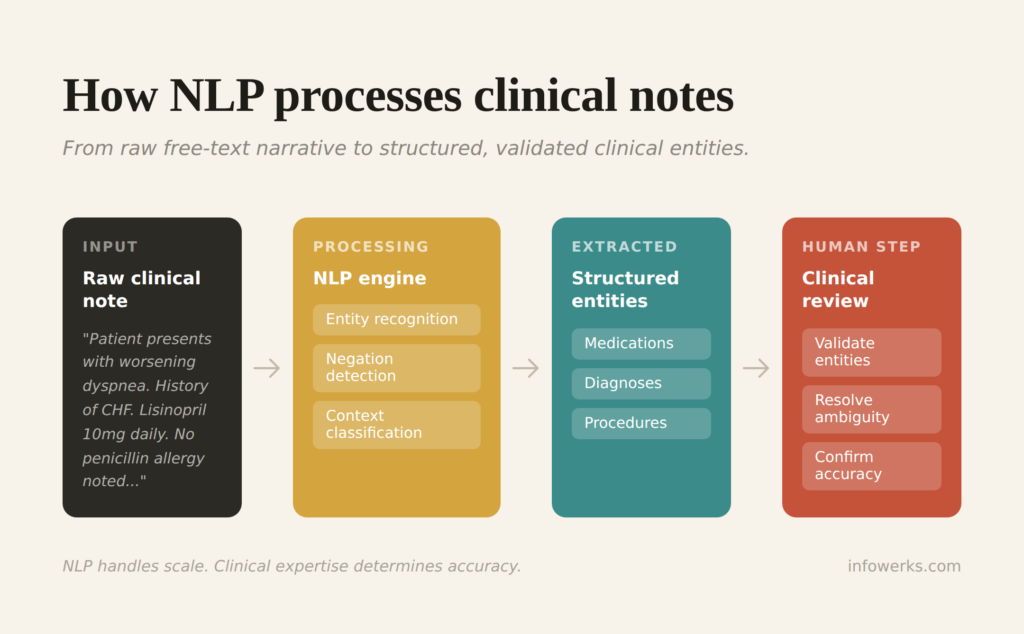
In the migration context, this matters for a few specific reasons.
First, it makes it possible to understand what clinical content is actually in the unstructured record before migration begins, rather than treating it as an opaque volume of documents. A health system preparing to migrate from one EHR to another can use NLP to assess whether its progress notes contain diagnosis mentions that are not reflected in the structured problem list, or whether discharge summaries reference medications that are not in the active medication list. Those gaps are migration planning information, not just clinical quality information.
Second, NLP extraction enables targeted validation of clinical narrative content after migration. Rather than confirming only that a note transferred and is viewable, a migration team can verify that the clinical entities in the pre-migration note are present and intact in the post-migration version. This is a meaningfully higher bar than document-level reconciliation.
The limitation that deserves equal emphasis: NLP models trained on clinical text are not infallible, and the consequences of errors in clinical data migration are not trivial. Negation errors, where a model identifies a diagnosis that was explicitly ruled out in the note, are a known failure mode. Contextual ambiguity, where the same phrase means different things in different clinical specialties, is another. NLP extraction in migration contexts is a tool for scale and coverage, not a substitute for clinical review of high-risk content.
Automated Field Mapping and Clinical Terminology Reconciliation
EHR-to-EHR migrations carry a specific complexity that general data migration does not: clinical terminology standards. A source EHR that uses ICD-10 codes for diagnoses and a destination EHR that stores diagnosis information in SNOMED CT requires more than a field-level mapping exercise. It requires terminology reconciliation, ensuring that a clinical concept expressed in one coding system is correctly represented in another without loss of meaning or precision.
This problem has existed as long as EHR migration has existed. What has changed is the tooling available to approach it. ML models trained on clinical terminology mappings between ICD-10, SNOMED CT, LOINC, and RxNorm can generate candidate mappings across large terminology datasets substantially faster than manual review. They can also identify mapping ambiguities, cases where a code in one system has multiple plausible equivalents in another, and surface those for human review rather than making a default choice.
The same principle applies to schema reconciliation between EHR platforms. Epic, Oracle Health, Meditech, and other major platforms each have their own data models, custom field conventions, and proprietary extensions. An ML-assisted mapping process can identify likely structural correspondences across source and destination schemas more quickly than a purely manual exercise. It can also flag the fields where no obvious correspondence exists and where a human decision is required about what happens to that data.
The practical constraint is the same as with NLP: the output of automated mapping is a starting point for expert review, not a finished product. Healthcare-specific knowledge, specifically an understanding of what clinical data means in practice and how it behaves in real workflows, is what separates a mapping that looks correct from one that is correct. That knowledge is not encoded in a mapping model.
Anomaly Detection in Clinical Data Validation
Validation is where EHR migration most commonly breaks down, and it is where anomaly detection tools are having a meaningful operational impact.
The traditional approach to migration validation involves reconciliation counts and targeted manual review. Record counts before and after migration are compared, a sample of records is reviewed for accuracy, and specific high-risk categories receive closer attention. This approach has two structural limitations: it confirms that records are present, and it reviews a fraction of the full dataset. Records that transfer completely but migrate incorrectly fall through both checks if they fall outside the review sample.
ML-based anomaly detection addresses this differently. Instead of sampling, it scans the full post-migration dataset for patterns that deviate from expected norms in ways that suggest migration errors rather than genuine clinical variation.
In the EHR context, the anomaly patterns that matter most are clinically meaningful. An active medication on the post-migration medication list that conflicts with a documented allergy in the allergy record. A problem list entry that does not appear in any encounter documentation across years of patient history. A lab result in a reference range that is physiologically implausible for the documented patient age and diagnosis. A surgical history that includes a procedure date that postdates the patient’s first encounter at the facility.
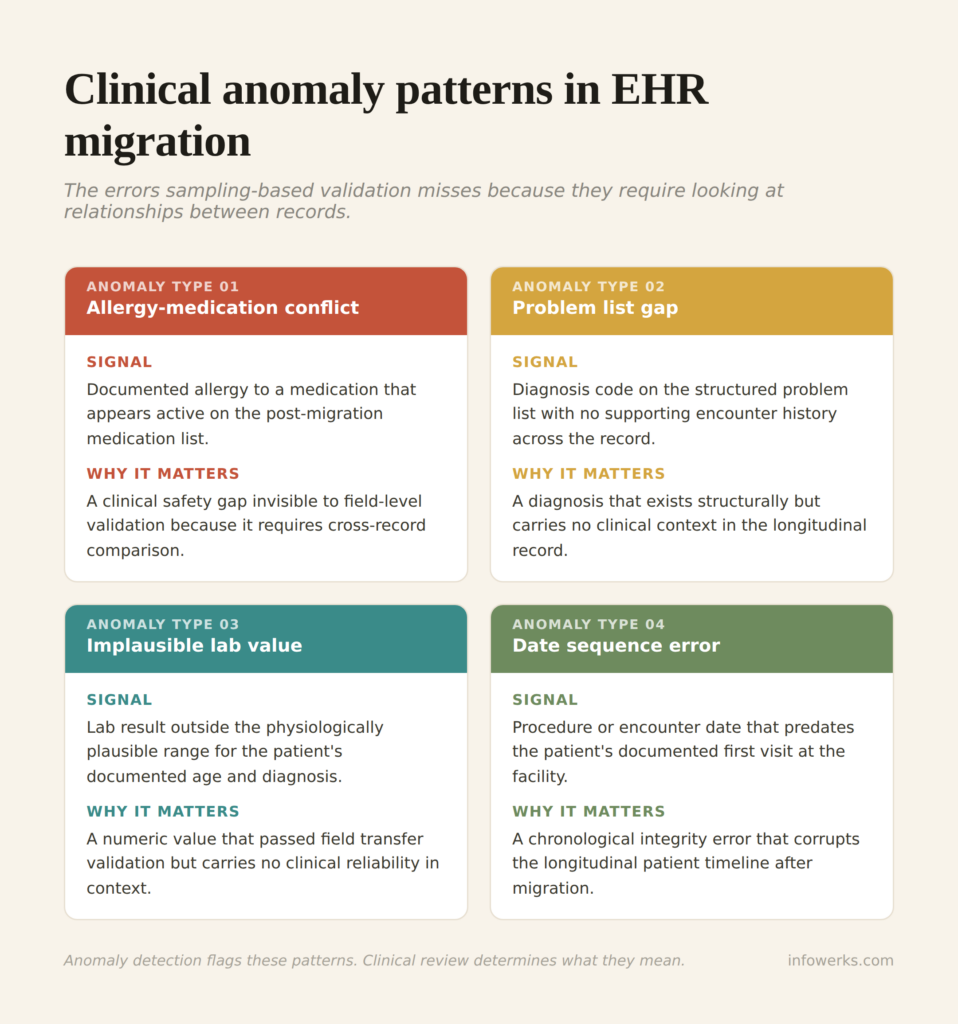
These are the kinds of errors that manual sampling misses, not because reviewers are careless, but because the dataset is too large and the patterns are too subtle to find without algorithmic help. Catching them before go-live, while the source system is still accessible for comparison, is meaningfully easier than catching them afterwards.
The distinction worth preserving is that anomaly detection flags records for review. It does not resolve them. The determination of whether a flagged record represents a migration error or a genuine clinical anomaly is a clinical judgment, and it belongs with someone who understands the clinical context.
AI-Assisted De-Identification at Scale
One of the more operationally demanding requirements in enterprise EHR migration is the creation and management of de-identified datasets for testing. Before production data moves to a new environment, most migration teams run test cycles against representative data that mirrors the structure and complexity of the real dataset but has had protected health information removed. At the scale of an enterprise EHR environment, producing that test data manually is not feasible.
AI-based de-identification tools identify and remove or mask the 18 categories of PHI defined under HIPAA’s Safe Harbor standard within clinical text and structured records. Within unstructured clinical notes specifically, this includes names, dates, geographic identifiers, contact information, and unique identifiers that may appear anywhere in the narrative rather than in defined fields. Pattern recognition models trained on clinical text can flag these identifiers across large document volumes substantially faster than a human review process.
The operational value is real: test migration cycles that previously required significant manual effort to produce a safe dataset can be run more frequently when de-identification is AI-assisted, which means more validation iterations before go-live and a better-tested migration.
The caution that belongs in this conversation is equally real. AI de-identification is not perfect. Unusual name patterns, novel identifier formats, and contextual PHI references that a model has not encountered in training can be missed. Producing de-identified test data for a migration using AI tools does not eliminate the need for human verification of that process, particularly for clinical note content where PHI can appear in unexpected forms. De-identification failures in a testing environment are not just privacy incidents; they can create compliance exposure that is difficult to document away.
Intelligent Data Quality Scoring
Before migration begins, the quality of the source data matters significantly to how the migration will go. A dataset with high rates of missing values, inconsistent coding, duplicate records, and structural irregularities will produce a more complex migration than a clean one. Identifying the extent and location of those quality issues before extraction starts is one of the most valuable things a migration team can do.
ML models can assess data quality across large EHR datasets by scoring records against completeness, consistency, and plausibility criteria simultaneously. A record-level quality score surfaces the portions of the source dataset that carry the most migration risk: records with missing required fields, records with coding that does not match the documented clinical context, and records with date sequences that suggest data entry errors. This scoring can be applied across millions of records in a fraction of the time that rule-based quality checks would require.
What the score produces is a prioritized audit list, not a resolved dataset. The records that score poorly still need human review to determine whether the quality issue represents a data entry error that can be corrected before migration, a legitimate clinical documentation pattern, or a systemic problem with how the source EHR was configured. The scoring makes that review targeted and efficient rather than exhaustive.
Where Human Review Is Still the Only Answer
The picture so far is accurate but incomplete without this part.
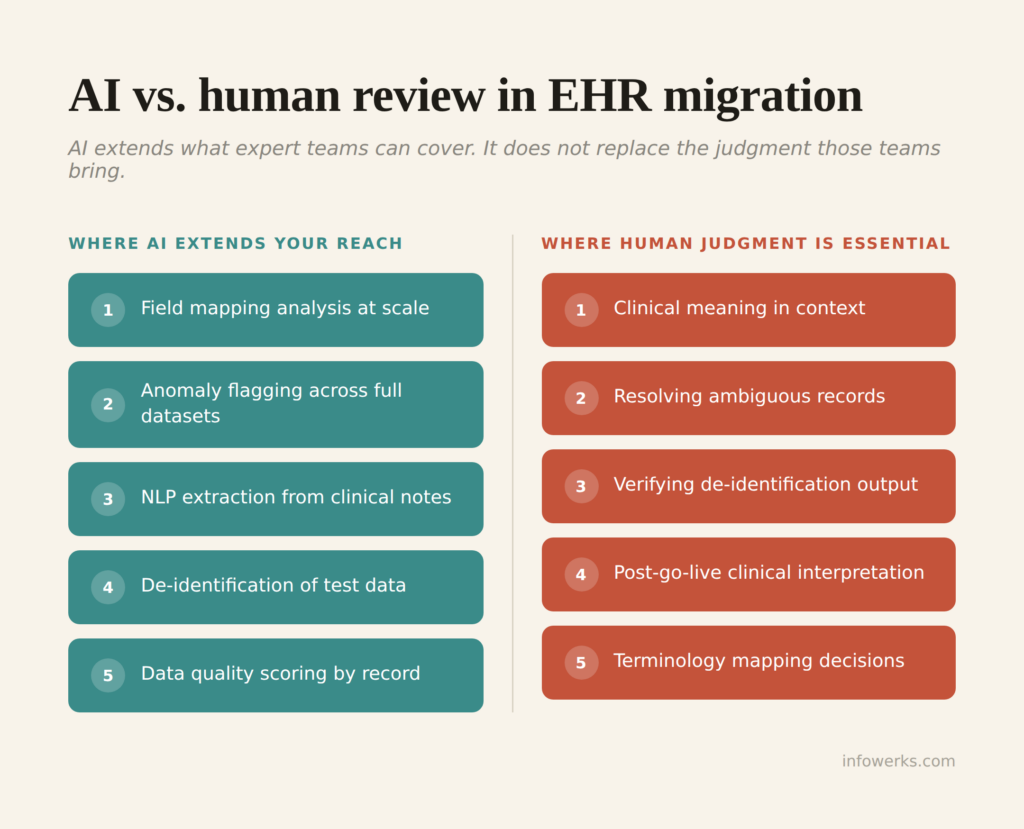
AI tools in EHR migration accelerate specific phases of work and extend what a migration team can cover. They do not replace clinical judgment, and in several specific areas, they cannot come close to substituting for it.
Clinical meaning in context is the clearest example. A progress note from 2019 that contains a medication mention, a diagnosis reference, and a functional status observation represents clinical judgment at a specific moment in a patient’s care. Whether the information in that note has been preserved correctly after migration is not a question a model can answer. It is a question that requires someone who understands what that note was documenting and what its absence or corruption would mean for ongoing care.
Ambiguous records are another area where AI tools surface the question but cannot answer it. A patient record with a documented allergy to a medication that appears on the active medication list might represent a migration error, a documented clinical decision to prescribe despite the allergy, or a data entry problem in the source system. A model can flag the inconsistency. Determining which of those three situations it represents, and what the right resolution is, requires clinical review.
De-identification verification is a third. As described above, AI de-identification tools can process large volumes of text, but the verification that no PHI remains is a human responsibility with real compliance implications.
The organizations that use AI tools most effectively in migration are the ones that are clear about what the tools are for. They accelerate coverage, surface patterns, and extend the reach of expert review. They are not a path to reducing the expertise required on a migration project. A migration team that deploys AI tooling well still needs clinical informatics knowledge, healthcare operations experience, and the judgment to interpret what the tools find.
What This Means Before Your Next Migration
The practical implications for organizations planning an EHR migration are straightforward.
When evaluating a migration partner, it is reasonable to ask what AI and ML tools they use and specifically where in the process. The more useful question is how they validate what those tools produce. A partner that can describe the clinical review process that sits on top of their NLP extraction, their anomaly detection output, and their data quality scoring is a partner whose AI tooling is being used correctly. A partner that presents AI tooling as the story rather than as a component of a larger methodology is worth scrutinizing.
It is also worth understanding that AI tooling in migration is most valuable in environments where the data is complex. Large volumes of unstructured clinical content, multi-site consolidations where source data quality varies across locations, and long-running legacy environments where data has accumulated without consistent governance are exactly the situations where the scale problem makes automated tooling necessary rather than optional. A smaller, single-site migration from a relatively modern EHR with limited free-text content may not need the full tooling stack. Knowing which situation you are in before the project is scoped is part of planning accurately.
The EHR data migration articles in this series cover the full planning and execution framework in detail. The EHR Data Migration: The Definitive Enterprise Guide covers the eight-phase methodology, and the EHR data migration checklist covers what needs to be confirmed before any data moves. For a detailed look at what choosing the right migration partner involves, including the questions that surface whether a team’s AI tooling is being used rigorously, the EHR migration partner evaluation guide covers that directly.
Frequently Asked Questions
What is NLP, and how is it used in EHR data migration?
Natural language processing is a branch of AI that enables computers to interpret and extract information from human language. In EHR migration, NLP tools are used to identify clinical entities, diagnoses, medications, procedures, and observations within free-text progress notes and reports. This makes it possible to understand what clinical content exists in unstructured records and to validate that it has transferred correctly, rather than treating clinical notes as documents to be moved without verifying their contents.
Can AI automate the field mapping process in EHR migration?
AI tools can significantly accelerate the initial mapping analysis by identifying likely correspondences between source and destination schema fields, including clinical terminology translations across ICD-10, SNOMED CT, LOINC, and RxNorm. The output is a candidate mapping that healthcare data experts review, refine, and validate. The automation handles scale; the expertise handles accuracy. Using AI-generated mapping without clinical review is a reliable way to introduce errors that are not immediately visible but surface in workflows after go-live.
How does anomaly detection in EHR migration differ from standard data validation?
Standard validation confirms that records transferred and that counts match. Anomaly detection scans the full post-migration dataset for patterns that suggest migration errors: allergy records conflicting with active medications, problem list entries with no supporting encounter history, lab values inconsistent with patient demographics. These are the errors that sampling-based review misses because they require looking at relationships between records, not just the records themselves.
What is AI-assisted de-identification, and why does it matter for migration testing?
Enterprise EHR migrations require test data that mirrors the structure of production data but has had patient-identifying information removed. AI tools can identify and remove the 18 PHI categories defined under HIPAA's Safe Harbor standard across large volumes of clinical text, making it feasible to run multiple test migration cycles at scale. Human verification of the de-identification output is still required, particularly for clinical notes where PHI can appear in unexpected forms that a model may not recognize.
Does using AI tools in migration mean the project requires less clinical expertise?
No. AI tools extend the reach of clinical and operational expertise; they do not substitute for it. The judgment required to interpret what anomaly detection finds, verify what NLP extraction produces, and determine whether a quality-scored record represents a correctable error or a legitimate clinical pattern is clinical judgment. Migration projects that deploy AI tooling well still require teams with healthcare-specific knowledge. The tooling makes that knowledge more effective at scale, not less necessary overall.
In Conclusion
AI is changing what is possible in EHR data migration, specifically at the points where scale has always been the limiting factor: unstructured clinical content, terminology reconciliation across large datasets, anomaly detection across millions of records, and de-identification for testing. These are real improvements with meaningful operational implications for enterprise migrations.
What has not changed is the underlying requirement for clinical and operational expertise in the team running the project. AI tools extend the reach of that expertise. They do not replace it. The distinction matters because the consequences of getting clinical data migration wrong sit in patient records, in care decisions, and in compliance documentation, none of which are domains where algorithmic confidence is an adequate substitute for verified accuracy.
The organizations that will handle AI-assisted migration well are the ones that treat the tools for what they are: faster ways to do the work that has always been necessary, not shortcuts around the parts of the work that have always been hardest.
Infowerks has been doing healthcare data conversion work since 1997, across more than 150 different software platforms. Our team applies AI-assisted tooling where it extends what rigorous, expert-led migration work can accomplish, not as a substitute for it. If you have an EHR migration on the horizon and want to talk through what your specific data environment involves, we are glad to have that conversation.
If you’re planning an EHR migration and want to understand what AI-assisted validation would look like for your environment, then talk to our migration team today at +1 702-914-9910.
This article was written by Shristi Patni and reviewed by Jeff Deitch, CEO and Co-Founder of Infowerks Data Services, with nearly 35 years of experience in healthcare data interoperability.